The Confession Advantage: Why Revealing What You Don't Know Closes More Deals Than Any Résumé Ever Will

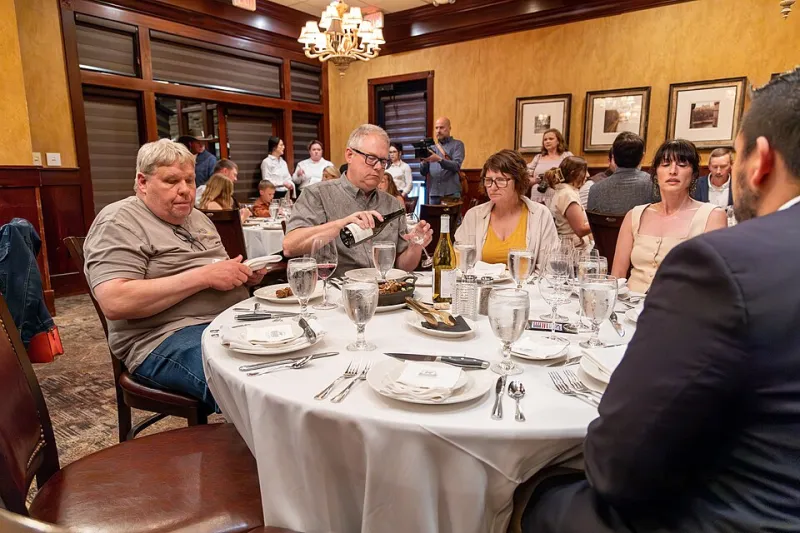
Photo: two business executives having candid conversation at formal dinner table, via img-s-msn-com.akamaized.net
There is a particular brand of executive who enters a business banquet armed with credentials, rehearsed talking points, and a mental catalog of achievements ready to be deployed at the first pause in conversation. They are impressive, often intimidating, and almost always forgettable by morning.
Then there is the executive who leans across the table midway through the second course and says, quietly and without apology, "Honestly, I'm still working through that part of the market. What's your read on it?"
That person leaves with three follow-up meetings scheduled before dessert is cleared.
The distinction is not accidental. It is strategic.
Why Expertise Repels at the Dinner Table
Business banquets occupy a unique psychological space. Unlike boardrooms or pitch decks, they are environments where the social contract demands reciprocity. Conversation is expected to flow in both directions. When one party dominates the exchange with uninterrupted demonstrations of knowledge, the dynamic shifts from dialogue to performance—and audiences, no matter how polite, disengage from performances.
The credential display also triggers a subtle competitive instinct. When an executive leads with everything they know, they implicitly challenge others at the table to match or surpass them. The conversation becomes a quiet contest rather than a genuine exchange. Defenses rise. Authenticity recedes.
Contrast that with the leader who introduces uncertainty into the room. Suddenly, the dynamic inverts. Others feel genuinely needed. Their perspectives carry weight. Their expertise is being sought rather than evaluated. That shift—from competition to contribution—is where real business trust is manufactured.
The Neuroscience of Being Asked
Research in organizational psychology has long established that people who feel heard and consulted develop faster and deeper affiliations with those who sought their input. In the context of a business banquet, this translates directly into relationship capital.
When a seasoned investor or corporate leader is asked a genuine question—not a rhetorical setup, not a networking gambit, but an honest inquiry from someone who actually wants to learn—the neurological response is one of value and relevance. The person being asked feels positioned as an authority. And people, universally, want to do business with those who recognize their authority.
This is the mechanism behind what might be called the Confession Advantage: by admitting a gap, you fill that gap with someone else's expertise, and in doing so, you make that person feel indispensable to your thinking. Indispensability is a short walk from partnership.
Strategic Transparency Is Not Weakness
A critical distinction must be drawn here. Strategic vulnerability is not the same as broadcasting incompetence. The executive who admits they are uncertain about Southeast Asian supply chain logistics while discussing a domestic expansion opportunity is demonstrating intellectual honesty. The executive who admits they do not understand their own balance sheet is simply underprepared.
The former invites collaboration. The latter invites concern.
Effective practitioners of this approach tend to follow a simple internal framework: they reveal uncertainty in areas where they are genuinely curious, where the person across the table has clear depth, and where the knowledge gap does not undermine confidence in their core competency. A founder who builds exceptional software products can freely admit they are still learning the nuances of institutional fundraising. That admission does not diminish their credibility as a builder—it enhances their credibility as a self-aware leader.
Self-awareness, it turns out, is among the most bankable qualities in a business partner.
Questions as Currency
At Business Builders Banquet events, where entrepreneurs, investors, and corporate executives occupy the same room with the shared expectation of meaningful exchange, the quality of the questions asked often matters more than the quality of the answers given.
The best dealmakers in these rooms are not necessarily the most knowledgeable. They are the most curious. They ask follow-up questions that demonstrate they were actually listening. They request clarification instead of pretending to understand. They invite disagreement rather than seeking validation.
This posture signals something that no credential can convey: intellectual security. The leader who is comfortable not knowing something is, by definition, not threatened by new information. And a leader who is not threatened by new information is a leader who can adapt, pivot, and grow. Those are exactly the qualities that long-term investors and strategic partners are looking for when they are deciding whom to back.
Practical Application: How to Deploy Vulnerability Without Losing Ground
For those accustomed to leading with authority, this approach requires deliberate practice. Several techniques tend to be effective in banquet settings specifically.
Anchor the admission to a genuine question. Do not simply state what you do not know—pair the admission with a specific question that invites the other person's perspective. "I'll be honest, I haven't spent much time in the Dallas commercial real estate market. How are you seeing the office-to-residential conversion trend playing out down there?" This construction is disarming and immediately productive.
Use the admission to create parity. High-status executives are often approached with deference, which can make conversations feel transactional and one-sided. A well-placed admission of uncertainty levels the table, creating the kind of peer-to-peer dynamic in which genuine business relationships are formed.
Follow up on what you learned. The admission is only the opening move. When you reference what someone told you—in a follow-up email, in a subsequent conversation, in a meeting two weeks later—you demonstrate that you were not performing curiosity. You were practicing it. That distinction is immediately apparent, and it is the foundation upon which durable business alliances are built.
The Long Game at the Banquet Table
The business banquet is, at its core, a theater of trust-building. Every word, gesture, and question is being processed by the people across the table, who are forming impressions that will outlast the evening and shape the decisions they make in the weeks that follow.
In that environment, the executive who arrives with every answer already prepared is playing a short game. They may impress in the moment. They rarely inspire over time.
The executive who arrives with genuine curiosity—who treats the dinner table as a place to learn rather than a stage on which to perform—is playing an entirely different game. One with far better odds.
At the end of the night, the deals that get done are not made by the person who knew the most. They are made by the person others most wanted to keep talking to. And nothing keeps a conversation alive quite like the sincere admission that you still have something to learn.