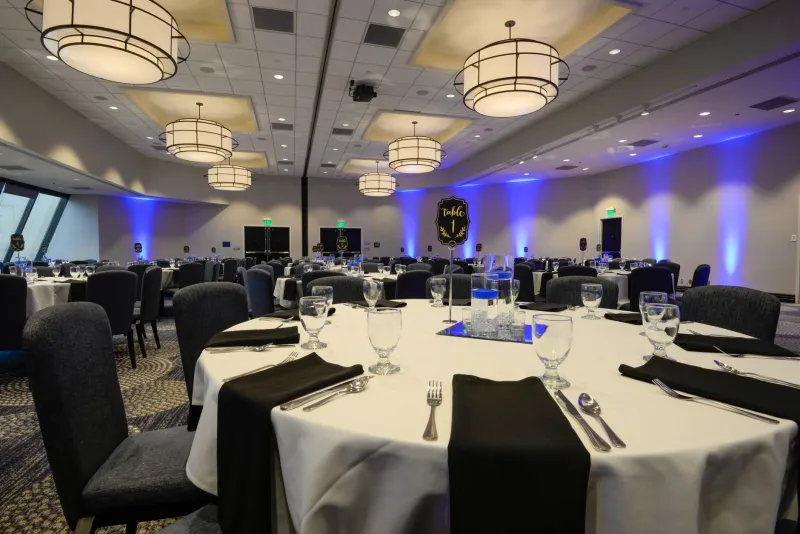
The Independent Table: Why the Most Powerful Move at a Business Banquet Is Arriving Entirely Alone

Photo: confident business executive standing alone at elegant corporate networking reception, via images.kabum.com.br
Picture two executives walking into the same business banquet on the same evening. The first arrives with her co-founder on one side and her head of business development on the other. They navigate the room as a unit, gravitating toward familiar faces, defaulting to internal conversation during lulls, and presenting themselves to the room as a team.
The second executive arrives alone. He checks his coat, takes a brief survey of the room, and walks directly toward a cluster of people he has never met.
By the end of the evening, the first executive has reinforced three relationships she already had. The second has built five new ones—including one with an investor who has been trying to access his sector for eighteen months.
This is not an unusual outcome. It is, in fact, the predictable result of a dynamic that plays out at business banquets across the country with remarkable consistency.
The Comfort Trap
The instinct to arrive at a professional event with familiar colleagues is understandable. Business banquets can be high-pressure environments, particularly when the guest list includes senior investors, corporate executives, and industry leaders whose attention and respect feel difficult to earn. Having trusted colleagues nearby provides psychological comfort and, in theory, social proof.
In practice, however, the presence of an inner circle functions as a gravitational field. It pulls attention inward. It offers an easy escape from the friction of introducing yourself to strangers. It creates a social buffer that, while comfortable, is also limiting.
When a group arrives together, they signal to the room that their social needs are already met. The unspoken message is: we are complete. Other attendees—particularly those who arrived solo or who are actively seeking new connections—read that signal accurately and redirect their attention toward more accessible targets.
The team that came together, in other words, leaves together. And leaves with what they brought.
What Solo Attendance Signals to the Room
Arriving alone at a business banquet communicates something specific and powerful to the people observing it—and at events of this caliber, people are always observing.
First, it signals independence. A leader who attends without requiring the presence of colleagues or partners projects confidence in their own ability to represent themselves, their organization, and their interests. This is not a trivial perception. Investors and strategic partners are not simply evaluating businesses—they are evaluating the people who lead them. A founder who cannot hold a room without their team raises questions about leadership capacity that no pitch deck can fully resolve.
Second, solo attendance signals availability. In the social architecture of a business banquet, the unaccompanied executive is the most accessible person in the room. They have no pre-existing obligations to attend to, no internal conversations to maintain, and no colleagues whose needs must be balanced against the demands of meeting new people. That accessibility is an asset that is immediately apparent to anyone scanning the room for meaningful connections.
Third, and perhaps most importantly, solo attendance signals intentionality. The executive who arrives alone has made a deliberate choice. That choice communicates that they are there to engage with the room—not to reinforce existing relationships, not to conduct internal business under the social cover of a formal event, but to genuinely explore what the evening has to offer.
Intentionality, in a room full of ambitious professionals, is magnetic.
The Connector's Positioning Advantage
One of the most significant structural benefits of solo attendance is the freedom it creates to function as a connector—arguably the most valuable role available at any business banquet.
Connectors move fluidly through a room. They introduce people to one another, draw disparate conversations together, and create the kind of relational density that transforms a single event into an ongoing network. The connector is not merely a participant in the evening—they become a node through which relationships flow, which means that every connection made through them carries their name and their credibility.
This role is structurally unavailable to executives who arrive with a team. The obligations of group attendance—checking in with colleagues, managing the group's social experience, maintaining internal cohesion—consume the time and attention that connector behavior requires. The solo attendee has no such obligations. Their evening is entirely their own, and they can spend it building the kind of cross-pollinating relationships that define elite networks.
Authenticity Under Pressure
There is a less frequently discussed benefit to solo attendance that deserves direct examination: it forces authentic conversation in a way that group attendance rarely does.
When a founder attends a banquet with their co-founder, they are, consciously or not, performing for an internal audience as much as an external one. Statements made in the presence of colleagues carry an implicit accountability that can subtly constrain candor. The instinct to present a unified front, to avoid contradicting a partner's position, or to maintain a particular image within the team can limit the authenticity of external interactions.
The solo attendee carries no such constraint. Without an internal audience, they are free to ask questions they might not otherwise ask, to admit uncertainties they might otherwise conceal, and to explore ideas that have not yet been fully formed internally. This openness—this willingness to think out loud with strangers—is precisely the quality that accelerates trust and invites genuine collaboration.
Some of the most productive conversations at business banquets happen not when someone is delivering a polished narrative, but when they are genuinely working through a problem in real time with someone they have just met. That kind of intellectual honesty is far easier to access when there is no one from the home team watching.
Practical Strategies for Solo Attendees
For executives accustomed to attending events with colleagues, the transition to solo attendance benefits from deliberate preparation.
Develop a brief, confident self-introduction. Without colleagues to provide social context, the solo attendee must be immediately clear about who they are and what they do. A crisp, jargon-free introduction that communicates your role, your organization, and one specific thing you are working on or looking for is sufficient. It invites follow-up questions and signals that you are there to engage, not to impress.
Identify two or three people you want to meet before you arrive. Most business banquets publish guest lists or speaker rosters in advance. Research them. Know who will be in the room and why they are relevant to your current priorities. Having a short list of intentional targets prevents the aimless drift that can undermine an otherwise productive evening.
Use the seating arrangement strategically. The solo attendee has more flexibility in choosing where to sit than someone managing a group. Position yourself at a table where you know no one. The discomfort of that choice will dissipate within minutes, and the conversations that emerge from it will almost always be more valuable than those conducted among familiar faces.
Embrace the friction. Walking into a room alone can feel uncomfortable, particularly when others appear to have arrived with ready-made social circles. Resist the impulse to reach for your phone or retreat to the bar. The discomfort is temporary. The connections made by leaning into it are not.
The Evening Belongs to the Unattached
At Business Builders Banquet events, where the explicit purpose is to connect leaders across industries and accelerate the kinds of relationships that produce real business outcomes, the solo attendee is not at a disadvantage. They are, by almost every meaningful measure, in the most advantageous position in the room.
They are accessible, intentional, independent, and free. Free to sit anywhere, speak to anyone, and follow any conversation wherever it leads—without negotiating with colleagues, without managing group dynamics, and without the invisible ceiling that internal obligations impose on external ambition.
The team that arrives together may feel stronger at the door. But by the time the final course is cleared, it is almost always the person who walked in alone who leaves with the most valuable new relationships in their pocket.