Seated at the Same Table: How Shared Meals Unlock Business Relationships That Digital Platforms Simply Cannot
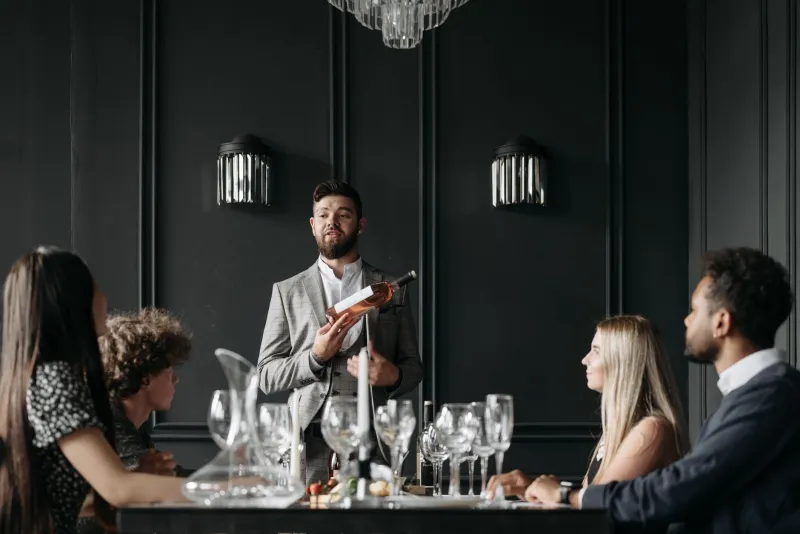
The Forgotten Currency of the Conference Room
For all the sophistication modern technology has introduced into the world of commerce — AI-driven CRM platforms, immersive virtual pitch environments, algorithmic matchmaking tools — a surprising truth persists at the highest levels of American business: the most consequential agreements are still forged over a well-set table. Not in a Slack channel. Not on a video call. At dinner.
This is not mere nostalgia. It is neuroscience.
When two individuals share a meal, their bodies engage in a synchronized physiological experience that behavioral economists and social psychologists have studied extensively. The act of eating together — particularly in a structured, convivial environment — triggers the release of oxytocin, the neurochemical most commonly associated with trust and social bonding. A landmark study published in Psychological Science found that individuals who ate the same food during a negotiation reached agreements faster and were significantly more cooperative than those who did not. The shared table, it turns out, is not a metaphor. It is a mechanism.
What the Data Says About Deal Close Rates
The anecdotal evidence has long been compelling, but quantitative research is now catching up. A 2022 analysis conducted by Forrester Research found that in-person business meetings — including structured dining events and conference banquets — closed deals at a rate approximately 34 percent higher than equivalent virtual interactions. A separate survey by the Harvard Business Review revealed that 95 percent of professionals considered face-to-face meetings essential for building long-term business relationships, even among executives who regularly conduct business remotely.
 Photo: Forrester Research, via img1.wsimg.com
 Photo: Harvard Business Review, via c8.alamy.com
Perhaps more striking is the data on investment conversations specifically. Venture capital firms that hosted in-person founder dinners reported a measurably shorter due diligence cycle compared to deals that originated through digital-only pipelines. The reasoning is straightforward: investors are not merely evaluating a pitch deck. They are evaluating a person. And a person reveals far more of themselves across a dinner table than across a screen.
This is precisely the philosophy that drives the Business Builders Banquet model — the understanding that where leaders meet, deals are made, and that the environment in which that meeting occurs shapes its outcome profoundly.
 Photo: Business Builders Banquet, via static1.bigstockphoto.com
The Psychology of the Shared Plate
To understand why dining accelerates trust, one must appreciate what eating together communicates at a primal level. For most of human history, sharing food was an act of vulnerability. You did not break bread with someone you considered a threat. The ritual signaled safety, reciprocity, and mutual investment — values that remain deeply embedded in the human psyche regardless of how sophisticated our business tools have become.
In a professional context, this translates into what behavioral economists call "environmental priming." The warmth, sensory richness, and relative informality of a dining setting lowers psychological defenses that a sterile conference room — or a video grid — tends to reinforce. Participants become more candid, more generous with information, and more emotionally present. These are precisely the conditions under which authentic partnerships are born.
Additionally, the structured cadence of a multi-course meal creates natural conversation rhythms. Unlike a meeting with a rigid agenda, a banquet allows dialogue to breathe — to migrate naturally from pleasantries to professional discovery to substantive negotiation and back again. That organic flow is extraordinarily difficult to manufacture in a virtual format.
Practical Strategies for Entrepreneurs and Executives
Recognizing the power of the table is one thing. Deploying it strategically is another. For entrepreneurs seeking to accelerate funding conversations or deepen partnership discussions, the following approaches have proven consistently effective.
Curate your guest list with intention. The most productive dining events are not open-door affairs. They are deliberately assembled gatherings where the attendee mix reflects complementary interests, industries, or investment theses. A founder seeking Series A capital should not simply attend any networking dinner — they should seek out or host events where the table includes operators who have navigated that same funding stage and investors actively deploying capital in their sector.
Invest in the environment. The setting of a business dining event communicates something about the host's judgment and ambition. A thoughtfully chosen venue — one that balances professionalism with warmth — signals to guests that they are valued. This is not about extravagance; it is about intentionality. A private dining room at a respected restaurant conveys far more than a hotel ballroom with banquet chairs and a cash bar.
Structure the conversation without scripting it. The most effective business dining events include light facilitation — a brief introduction of attendees, perhaps a single opening question posed to the table — without devolving into a structured presentation format. The goal is to spark organic dialogue, not to replicate a webinar with cutlery.
Follow up within 24 hours, specifically. The trust bond created at a shared meal has a half-life. A generic follow-up email squanders the momentum generated at the table. Instead, reference a specific exchange from the evening — a detail the other person shared, a point of genuine agreement — to demonstrate that the connection was real and not transactional.
Why Digital Tools Serve the Table, Not the Other Way Around
None of this is an argument against digital communication. LinkedIn, email, and video conferencing platforms are invaluable for maintaining relationships, distributing information, and conducting the logistical work of business. But they are instruments of efficiency, not instruments of trust.
The most effective business builders in America today understand this distinction intuitively. They use technology to prepare for the table and to sustain relationships forged there — but they do not mistake the map for the territory. The relationship itself, the kind that survives market downturns and organizational change, is built in person.
In a business landscape increasingly saturated with digital noise, the willingness to invest in a shared meal has become a genuine differentiator. It signals seriousness of intent, respect for the other party's time, and confidence in one's own ability to build rapport without the buffer of a screen.
An Invitation to Reconsider Your Networking Strategy
If your current business development strategy relies primarily on cold outreach, virtual pitch calls, and social media engagement, you are competing in the most crowded arena in the history of commerce. Every entrepreneur with a laptop and a LinkedIn Premium subscription has access to the same digital channels you do.
The table, however, remains a space of genuine scarcity and genuine advantage. There are only so many seats, and the leaders who occupy them consistently are the ones who understand that business — at its most fundamental level — is a human endeavor. It always has been. And no algorithm has yet been written that changes that.
At Business Builders Banquet, we believe that the most powerful networking infrastructure is not a platform. It is a room, a meal, and the right people seated together with purpose. That is where the real work begins.